
Description
Doxycycline
Most antibiotics don’t reach inside cells. Doxycycline does, which is why it covers infections that amoxicillin and other beta-lactams simply can’t touch — chlamydia, the rickettsia behind Rocky Mountain spotted fever, the organism responsible for Lyme disease, atypical pneumonia caused by Mycoplasma. The list of things doxycycline works against is unusually broad for a single drug, and that breadth is the reason it appears in so many different clinical situations.
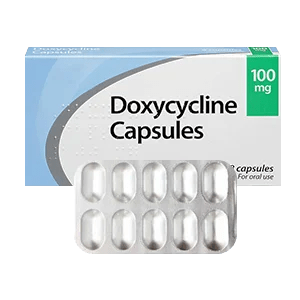
Available in 100 mg and 200 mg tablets. Also used at much lower doses — 50 mg daily for months — in the long-term treatment of acne, which is a different application than acute infection treatment and comes with a different risk profile.
Dosing
For most infections in adults and adolescents over 45 kg: 200 mg on day one (either as a single dose or split into two 100 mg doses), then 100 mg daily. Severe infections stay at 200 mg throughout.
Body-weight dosing applies under 45 kg: 4.4 mg/kg on day one, then 2.2 mg/kg daily.
For STIs including chlamydia: 100–200 mg daily for 10 to 14 days. Acne: 50 mg daily for 6 weeks to 3 months. Minimum treatment duration for most infections is 7 to 10 days — shorter courses risk incomplete eradication.
One thing worth knowing about how you take it
 Doxycycline can cause serious esophageal irritation or ulceration if it sits in contact with the esophageal wall. Take it with a full glass of water and stay upright — seated or standing — for at least 30 minutes after each dose. Don’t take it immediately before bed. This is more important than most packaging makes it sound.
Food and milk have less effect on doxycycline absorption than on older tetracyclines — taking it with food to reduce stomach upset is generally acceptable. High-calcium foods and antacids can reduce absorption somewhat; spacing these by a couple of hours is reasonable. Iron supplements and calcium-containing antacids should also be separated by at least two hours.
Sun sensitivity
Doxycycline causes significant photosensitivity. This isn’t a minor precaution — patients on doxycycline burn faster and more severely than usual. Use sunscreen and limit sun exposure during treatment, particularly in summer.
Who should not take it
Children under 12: doxycycline binds calcium in developing bones and teeth, causing permanent discoloration and potentially inhibiting bone growth. This is a hard contraindication regardless of indication.
Pregnancy, particularly the second and third trimesters: the same calcium-binding mechanism affects fetal dental and bone development. First-trimester safety data is also insufficient.
Breastfeeding: doxycycline appears in breast milk. Theoretical risk of tooth staining in the infant has not been conclusively confirmed, but most guidelines recommend avoiding it during breastfeeding.
Severe liver disease, leukopenia, porphyria, and hypersensitivity to tetracyclines are additional contraindications.
Side effects
Nausea, vomiting, diarrhea, and abdominal discomfort are the most common — taking it with food helps. Esophageal ulceration, as noted above, is a real risk if the drug isn’t taken correctly.
Skin rash and itching occur in some patients. Photosensitivity reactions — including exaggerated sunburn and, rarely, more severe phototoxic reactions — are more common with doxycycline than with most antibiotics.
With long-term use (acne treatment): laboratory monitoring every 2 to 3 weeks is standard practice. Prolonged courses have been associated with hepatotoxicity, and effects on sperm parameters have been observed in animal studies, though human clinical significance remains unclear.
Yellowing of skin or eyes, difficulty swallowing, unusual bleeding, blood in urine or stools: these warrant stopping the drug and contacting a prescriber.
Alcohol
Chronic heavy alcohol use modestly reduces doxycycline’s half-life by inducing liver enzymes — a minor pharmacokinetic interaction, not a dangerous one. Occasional drinking during a course is not clinically prohibited, but alcohol doesn’t help recovery from any bacterial infection.